


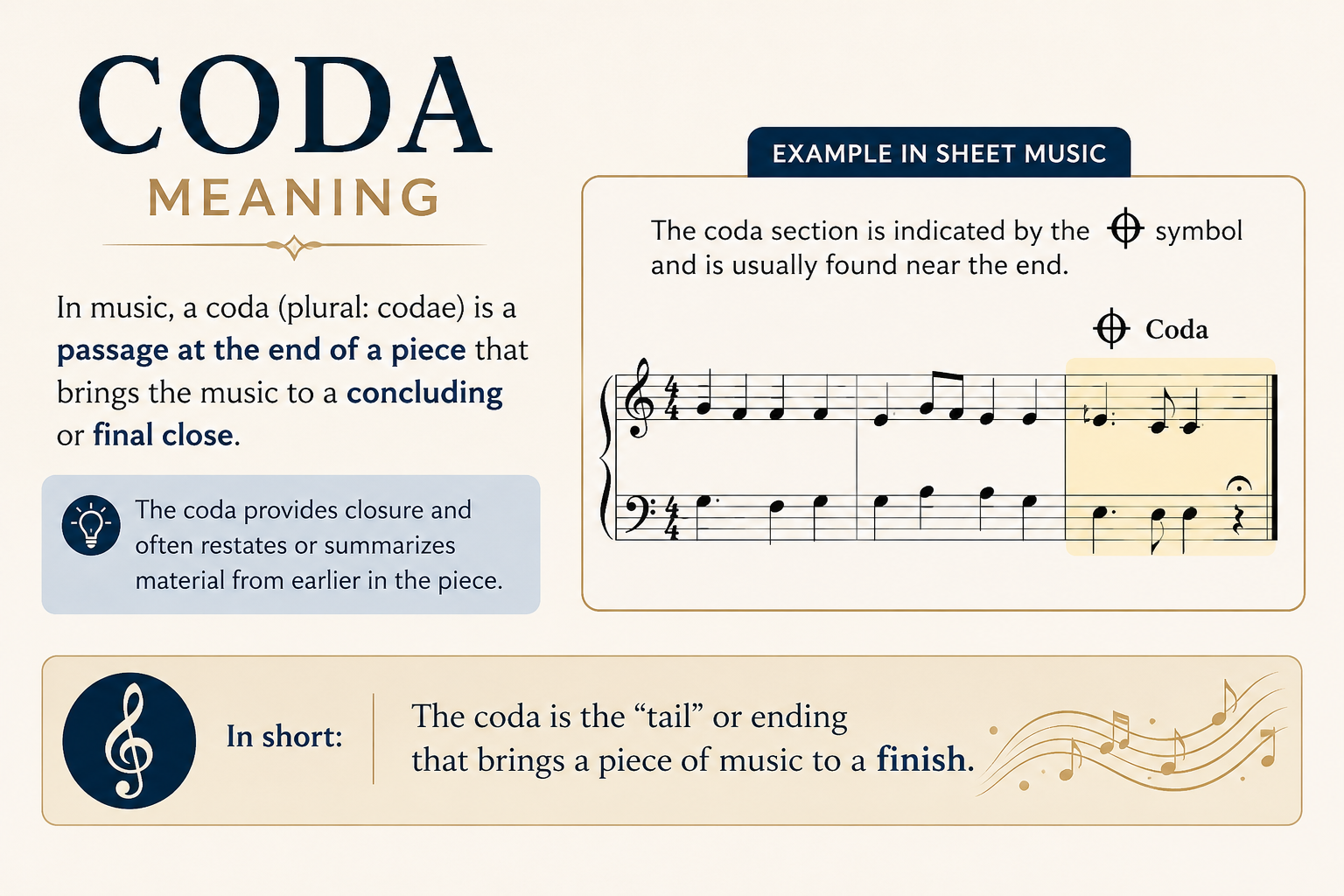
Introduction
Coda Meaning: The word coda is one of those fascinating terms that appears in different fields while maintaining a similar core idea. Although it originated in music, the word has gradually found its way into literature, speeches, films, and even everyday conversations. Many people come across the term and wonder about its exact meaning, especially when they see it used outside of musical contexts. Coda Meaning Understanding the meaning of coda can help you appreciate not only music but also the way stories, presentations, and even life events are structured.
Coda Meaning: At its heart, a coda is something that brings a piece of work to a satisfying conclusion. Rather than simply ending abruptly, a coda offers closure, reinforces important themes, and leaves the audience with a lasting impression. This makes it a valuable concept in both artistic and practical settings.
In this article, we’ll explore the meaning of coda in detail, its origin, how it is used in music and literature, its significance in modern communication, and why this simple word continues to hold such an important place across different creative disciplines.
What Does Coda Mean?
Coda Meaning: The term coda comes from the Italian word coda, which literally means “tail.” Just as the tail is the final part of an animal’s body, a coda refers to the concluding section of a larger work. It serves as the final segment that wraps everything up and provides a sense of completion.
Coda Meaning: most common usage, a coda appears in music as the ending passage of a composition. However, over time, writers, filmmakers, and speakers began borrowing the concept because it perfectly describes a thoughtful ending that extends beyond a simple conclusion. Instead of stopping immediately after the main content, a coda offers additional context, reflection, or emotional resolution.
Today, the word has expanded far beyond music. You might hear someone refer to the “coda” of a speech, a novel, a movie, or even a significant chapter in someone’s life. In each case, it represents the final portion that ties everything together while leaving the audience with a meaningful takeaway.
The Origin and History of the Word Coda
The history of the word coda traces back to Italy, where musicians used it to identify the closing section of a musical composition. During the classical period, composers needed a way to indicate that performers should move to a special ending after repeating certain sections. The term “coda” became the standard label for this purpose.
As classical music gained popularity throughout Europe, the terminology spread along with it. Composers such as Mozart, Beethoven, Haydn, and later Romantic composers frequently incorporated codas into their works. In many cases, these endings were not short or simple. Instead, they became dramatic, emotionally powerful finales that elevated the entire composition.
Coda Meaning:, scholars and writers noticed that the concept applied equally well to storytelling and communication. By the twentieth century, the word had entered everyday English vocabulary and was no longer limited to discussions about music. Today, it remains a versatile term that conveys the idea of an intentional, satisfying conclusion.
Coda Meaning in Music
Music is where the term coda truly belongs, and understanding its role here makes it easier to appreciate its broader meanings. In musical compositions, the coda is the final section that concludes the piece after the main themes have already been introduced and developed.
A musical coda often revisits familiar melodies while adding fresh energy or emotional depth. Instead of simply repeating earlier material, composers frequently modify the themes, increase the intensity, or gradually slow the tempo to create a memorable ending. This helps listeners feel that the journey has reached its natural destination.
Not every composition includes a lengthy coda, but many famous classical works feature one. In symphonies, sonatas, concertos, and even modern songs, the coda provides closure while emphasizing the emotional message of the music. Whether the ending is powerful, peaceful, or dramatic, the coda ensures that the audience leaves with a lasting impression rather than feeling that the piece ended too suddenly.
Coda Meaning in Literature and Writing
The concept of a coda extends beautifully into literature and other forms of writing. In books, essays, and articles, a coda functions as a concluding section that goes beyond a standard ending. Instead of merely summarizing the content, it often adds reflection, emotional insight, or a final perspective.
Authors use codas to revisit important themes that appeared throughout the story. They may reveal what happened to the characters after the main events, explain the broader significance of the narrative, or invite readers to think more deeply about the central message. This additional layer creates a stronger emotional connection between the work and its audience.
Coda Meaning:, a coda may appear as a closing reflection that ties together key ideas while encouraging readers to apply what they have learned. This approach feels more natural than ending with a simple conclusion because it provides a sense of completeness and lasting relevance.
How Coda Is Used in Everyday Language
Although coda began as a technical musical term, it has become increasingly common in everyday speech. People now use it metaphorically to describe the final stage of almost anything that unfolds over time.
Coda Meaning: For example, someone might describe a retirement celebration as the coda to a long and successful career. In this context, the retirement event is not just an ending but a meaningful conclusion that reflects everything accomplished along the way. Similarly, a final scene in a movie that reveals the characters’ futures could also be called a coda.
Even in business presentations or public speeches, speakers sometimes include a brief coda that leaves the audience with one final thought or inspirational message. Rather than ending immediately after presenting facts, they use the coda to strengthen the emotional impact of their presentation and make their message more memorable.
Why Codas Are Important
Coda Meaning: A well-crafted coda gives people the emotional closure they naturally seek. Whether listening to music, reading a novel, or watching a film, audiences generally appreciate endings that feel complete rather than abrupt. The coda fulfills this need by connecting the ending with everything that came before it.
Coda Meaning: From a creative perspective, codas provide artists and writers with an opportunity to reinforce their main themes. Instead of introducing entirely new ideas, they revisit familiar concepts from a fresh angle. This strengthens the overall message while helping audiences better remember the work.
Psychologically, endings have a significant influence on how people remember experiences. Research has shown that final moments often shape lasting impressions. A thoughtful coda takes advantage of this tendency by ensuring that the audience finishes the experience with clarity, satisfaction, and emotional resonance.
Examples of Coda in Different Contexts
Coda Meaning: One of the easiest ways to understand the meaning of coda is by looking at examples from various fields. In classical music, the final section of Beethoven’s symphonies often serves as a coda, bringing the musical journey to a dramatic and unforgettable conclusion.
In literature, an author may include a short chapter after the main ending that reveals where the characters are several years later. Although the primary conflict has already been resolved, this additional chapter provides emotional closure and answers lingering questions. That final chapter can be considered a coda.
Coda Meaning: In films, audiences frequently see a brief scene after the main climax that shows how life continues for the characters. This scene does not introduce a new conflict but instead reinforces the story’s message. Similarly, in public speaking, a motivational speaker may finish with a personal story that summarizes the presentation’s central lesson. That closing reflection functions as a coda.
Common Misunderstandings About the Word Coda
Many people mistakenly assume that a coda is simply another word for “ending.” While the two concepts are related, they are not exactly the same. Every coda is an ending, but not every ending qualifies as a coda. A true coda adds something meaningful beyond merely stopping the narrative or performance.
Coda Meaning: Another misconception is that codas are only found in classical music. While the term originated there, it is now widely used in literature, film, journalism, education, and everyday communication. Its flexibility has made it a valuable part of modern vocabulary.
Some also confuse a coda with an epilogue. Although they share similarities, an epilogue usually provides additional narrative information after the main story has ended. A coda, on the other hand, focuses more on emotional or thematic closure. Depending on the context, a single section may even function as both.
Frequently Asked Questions (FAQs)
1. What does coda mean?
A coda is the final section of a piece of music, writing, speech, or story that provides a clear and satisfying ending. The word comes from Italian and literally means “tail.”
2. What is the meaning of coda in music?
In music, a coda is the concluding passage of a composition. It helps bring the piece to a complete and memorable finish after the main themes have been presented.
3. Is coda only used in music?
No. Although the term originated in music, it is now also used in literature, films, speeches, and everyday language to describe the concluding part of something.
4. What is the origin of the word coda?
The word coda comes from the Italian language, where it means “tail.” It was first used in music before becoming common in other fields.
5. How is coda used in literature?
In literature, a coda is a short concluding section that wraps up the story, reinforces the main message, or gives readers additional context after the main narrative ends.
6. What is the difference between a coda and a conclusion?
A conclusion summarizes the main points, while a coda provides a final touch or ending that leaves a lasting impression. In music and storytelling, a coda often adds emotional or creative closure rather than simply summarizing.
7. Can the word coda be used in everyday conversations?
Yes. People sometimes use the word coda to describe the final event or closing moment of an experience, project, speech, or discussion.
8. Why is understanding the coda meaning important?
Understanding the meaning of coda helps you recognize how endings work in music, literature, films, and communication. It also improves your vocabulary and understanding of creative works.
Conclusion
Understanding the coda meaning reveals much more than the definition of a single word. It introduces a timeless concept that emphasizes the importance of thoughtful endings. Whether in music, literature, speeches, films, or everyday life, a coda serves as the final touch that brings everything together in a meaningful and memorable way.
Coda Meaning: origins in Italian musical tradition remind us that endings deserve as much attention as beginnings. A strong coda does more than signal that something is over—it reinforces important ideas, deepens emotional impact, and leaves audiences with a lasting impression that stays with them long after the experience has ended. Coda Meaning:
As language continues to evolve, the word coda remains as relevant as ever. Knowing its meaning allows you to better appreciate creative works, communicate more effectively, and recognize the value of ending any journey with purpose, clarity, and grace. Whether you’re reading a novel, listening to a symphony, writing an article, or delivering a presentation, understanding the role of a coda can help you see why the final moments often become the most memorable ones.Coda Meaning:
You May Also Read:
How Many Weekends in a Year
Pinoroduct Com: A Complete Guide to Features, Benefits, and What Users Should Know

